


Every day, thousands of businesses spend money on Facebook ads. They boost posts, launch campaigns, test audiences, tweak creatives, and watch the numbers move inside Ads Manager. Clicks go up. Impressions look strong. Cost per result seems “reasonable.”
But when you ask a simple question, “What’s the actual return?”, things get quiet.
That’s because only a small percentage of advertisers understand how to measure Facebook Ads ROI properly. They don’t just look at ROAS on the dashboard. They connect ad spend to real revenue, margins, customer lifetime value, and cash flow. That’s the difference between running ads… and running a profitable ad machine.
In this guide, I’ll break down how to measure Facebook ROI the right way, the tools and formulas that matter, and how to maximize your return instead of just tracking cheap clicks.
If you care about profit more than blurry metrics, let’s get into it.
Feeling stuck? Contact our social media agency
What Facebook Ads ROI Really Means (What It Does Not)
In simple words, Facebook advertising ROI is how much money you make compared to how much you spend on ads. For example, if you spend $1,000 on Facebook ads and generate $4,000 in sales, your ROI is positive; you made more than you spent.
If you spend $1,000 and only make $800, your ROI is negative; you lost money.
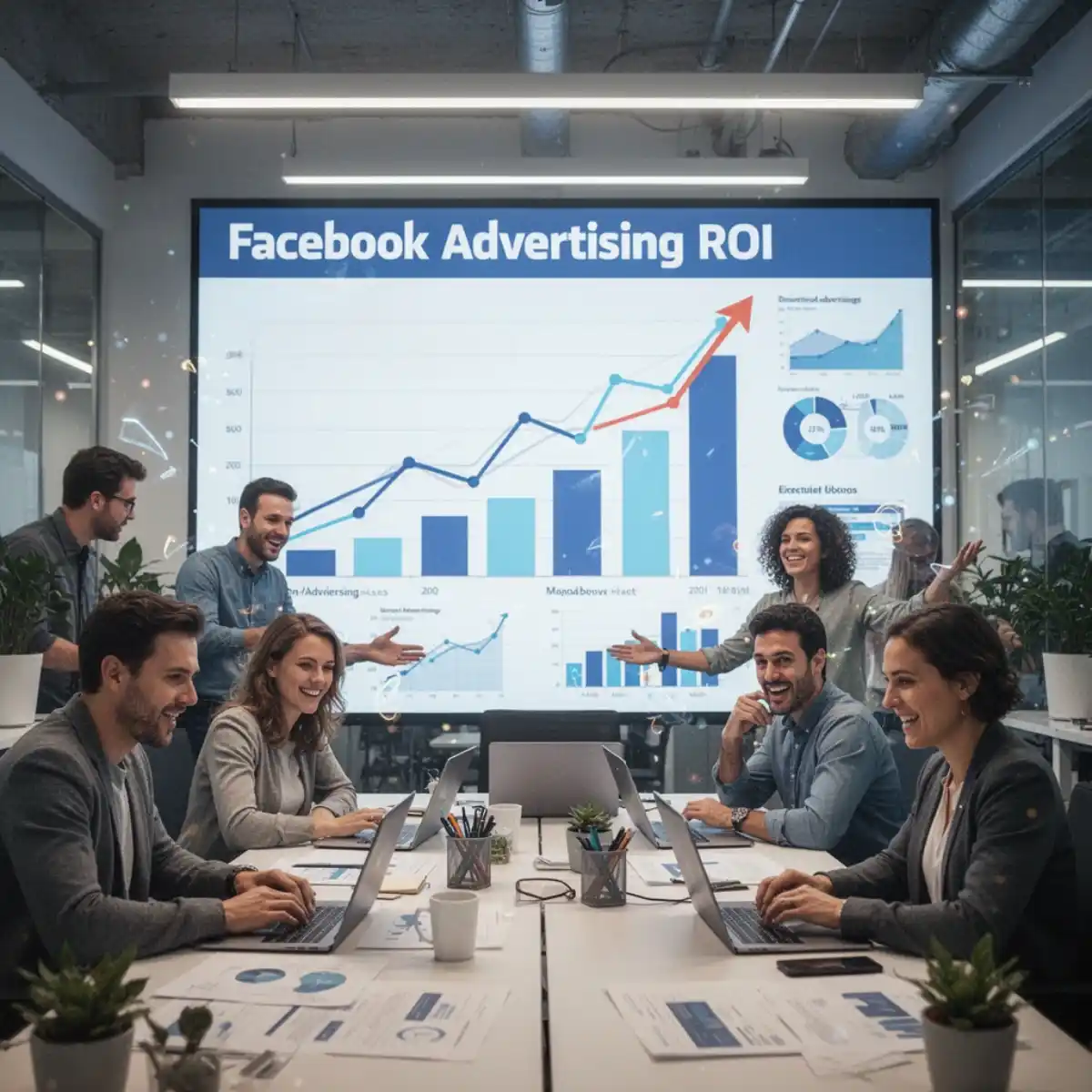
Average Facebook Ads ROI by Industry
The cross-industry average for Facebook ads ROI is approximately 2.8x. However, comparing your performance to a generic average is often misleading because profit margins and customer lifecycles vary wildly between a local plumber and a global apparel brand.
The following table reflects the performance benchmarks based on aggregate data from major platform reports:
As you see, industries like Legal and Education currently see some of the highest ROIs because their services carry high lifetime values, allowing for a more aggressive Facebook advertising costs upfront.
E-commerce metrics appear lower in terms of percentage, but because they benefit from frequent repeat purchases, they often achieve the highest absolute profit when scaled correctly.
If your industry benchmark is 3.5x and you are sitting at 2.0x, it is a clear signal that your Facebook ads are not working because of a mismatch between your creative and your landing page, rather than a flaw in the platform's algorithm.
Also read: Instagram Ads Cost in 2026
Average Facebook Ads ROI by Campaign Type
The objective you select in Ads Manager does more than just define your goal; it dictates which version of the Meta algorithm handles your money.
For instance, according to performance data, Advantage+ Shopping Campaigns (ASC) consistently deliver a 15–25% higher ROAS than manual sales setups because they utilize predictive AI to bypass traditional interest-based targeting.
It is a common mistake to assume that a Traffic campaign will eventually lead to a high ROI. Meta’s algorithm has become so segmented that it will find you professional "clickers" who never buy if you optimize for traffic.
So, if your goal is profit, you must optimize for Sales or Leads.
When my clients find that their Facebook ads are not working despite high engagement, the first thing our agency looks for is a misalignment between the campaign objective and their actual financial goals.
Moreover, Manual Bidding (Cost Caps) still plays a vital role for brands with tight margins.
While ASC is great for scaling, manual bidding allows you to set a floor for your ROI, ensuring you don't spend a dime unless Meta's AI predicts a conversion within your profitable range.
Also read: 6 Proven Ways to Effectively Manage Your Facebook Page
The Biggest Factors That Increase Facebook ROI Fast
I know many advertisers who spent weeks tweaking lookalike audiences while ignoring the foundational setup that really matters. Today, Meta’s AI handles the distribution, while your job is to handle the persuasion.
The solution can never be found in the technical settings of the Ads Manager if ROI is absent.
If I had to improve Facebook ROI quickly inside an account, I wouldn’t start with bid strategies, but fundamentals.
Offer Strength Beats “Optimization”
The most sophisticated Facebook ads audits show that a mediocre offer cannot be saved by great targeting. I've noticed that the highest ROI comes from no-brainer offers that reduce the friction of the first transaction.
In the current landscape, this often means moving away from a standard 10% discount and toward a value-first bundle or a low-risk entry point.
If your offer doesn't immediately solve a specific pain point or provide an obvious price-to-value advantage, your cost will remain high regardless of how much you optimize the campaign.
Before running a full audit, I usually ask one question: Would I personally stop scrolling for this? If the answer is no, ROI won’t improve.
Creative Volume and Testing Cadence
Meta’s Andromeda algorithm requires a constant feed of high-quality creative to find new pockets of buyers. The winner of last month rarely stays the winner of this month.
A high ROI is maintained by a rigorous testing cadence; typically, 3 to 5 new creative concepts per week for scaling accounts.
It’s always a good practice to test different angles, hooks, and formats (UGC, static, and motion graphics) to see which one resonates with the AI's current audience clusters.
Related article: Digital Marketing Pricing in 2026
Landing Page Conversion Rate
You can have the best ads in the world, but if your landing page is slow, confusing, or unoptimized for mobile, you are essentially setting your budget on fire.
Even a 1% increase in landing page conversion rate can double the total ROI for Facebook ads. This means utilizing CAPI to ensure the landing page data flows back to Meta accurately.
It’s as simple as this: If the algorithm doesn't see the conversion because of some issue on your site, it cannot optimize your spend effectively.
Retention Systems That Rescue ROI
True profitability is often won on the backend. I've worked with many clients whose initial ROAS was a modest 2.0x, but their real ROI was 6.0x because they had excellent email and SMS retention flows in place.
These systems rescue your ROI by turning a one-time purchaser into a repeat buyer without you having to pay for the click a second time.
You are leaving the most profitable part of the funnel on the table when you don’t integrate your Facebook ads management services with a solid retention strategy.
What a “Profitable” Facebook Account Looks Like?
Profitability is often found in the structural discipline of the account. We have audited hundreds of ad sets where the ROAS looked phenomenal, but the business was losing money because the account was cannibalizing organic sales or overspending on existing customers.
A truly profitable setup is designed to prove its own value through clear segmentation and ironclad data.
Prospecting and Retargeting Are Separated
While Meta’s Advantage+ tools often combine these, it is best to maintain clear boundaries to understand where their growth is coming from.
Prospecting (cold traffic) should be the engine that finds new people who have never heard of you. Retargeting should be the closer that handles objections. If you mix them without exclusions, you risk your team taking credit for sales that would have happened anyway.
New Customer Acquisition Is Measured Explicitly
The most successful brands prioritize nCAC (New Customer Acquisition Cost) over blended ROAS. It is easy to look profitable when you are spending 50% of your budget on people who have already bought from you three times.
A profitable account explicitly tracks how much it costs to acquire a person who has never interacted with the brand. If your cost for a new customer is below your target threshold, you have a green light to scale. If not, you are simply churning your existing audience.
Tracking Is Set Up to Reflect Reality
You cannot manage what you cannot measure. Accounts utilizing a Conversions API with server-side tracking consistently report 15–30% more accurate data than those relying on browser-side pixels alone.
A profitable account ensures that EMQ scores are high. Without this, Meta’s AI is flying blind, optimizing for the wrong users because it doesn't see the full picture of who is converting on your site.
Also read: Is Facebook Advertising Still Worth It in 2026?
How to Measure Facebook ROI in 2026 Without Getting Fooled
The biggest mistake an advertiser can make is trusting the Ads Manager dashboard as a definitive source of truth. To find your true Facebook ads ROI, you need to move beyond standard attribution and look at the actual causal impact of your spend.
The Shift to Incremental Attribution
In early 2026, Meta rolled out its Incremental Attribution model globally. This has been a game-changer for my clients because it uses machine learning to differentiate between a passive conversion and an incremental one.
These models have driven a considerable increase in incremental conversions compared to standard models.
Standard Attribution credits the ad if a user clicks and buys within 7 days. Whereas Incremental Attribution credits the ad only if the AI determines the user would not have bought without seeing that specific impression.
Also read: How to Set Up Meta Pixel
Running Conversion Lift Studies
If you want to stop guessing, you need to run a Lift Study to save you thousands of dollars by identifying campaigns that look profitable but are redundant.
Meta’s platform now allows you to split your audience into two groups:
- Test Group: Sees your ads as usual.
- Control Group: A statistically identical group that is intentionally withheld from seeing your ads.
If the control group converts at nearly the same rate as the test group, it is a clear signal that your Facebook ads are not working to drive new growth, even if the ROAS looks high.
Calibration via Geo-Testing
For larger brands, I often recommend Geo-Testing (or Geo-Lift). This involves pausing all Meta spend in specific geographic regions while maintaining spend in others. By comparing the total organic sales in the dark regions versus the paid regions, you can calculate your Incrementality Factor.
For example, if Meta reports $10,000 in sales, but your geo-test shows only $7,000 of that was extra revenue, your Incrementality Factor is 0.7.
You should then multiply your dashboard ROAS by 0.7 to find your real return. This level of ad management is what separates the scaling brands from those that eventually hit a plateau.
The Biggest Mistakes That Kill ROI (Even When Ads “Perform”)
Businesses focus so much on the technical delivery of their ads that they ignore the structural cracks that eventually drain their profits.
To maintain a healthy return on investment, you have to recognize when an ad that is performing well is really just a liability in disguise.
Scaling Spend Too Fast
One of the most common mistakes I see is the scaling panic. When a client sees a 5.0x ROAS on a $100/day budget, the instinct is to immediately jump to $1,000/day.
As you scale, your advertising cost naturally rises because you are reaching fewer "ready-to-buy" segments of the audience. Scaling by more than 20% every 48–72 hours often resets the learning phase, causing the algorithm to lose its efficiency and tank your return before the new budget even settles.
Tracking Low CPC and Cheap Leads
The cheapest traffic is usually the most expensive in the long run. It is easy to get a low Cost Per Click (CPC) or $2 leads, but if those people never buy, your ROI is zero.
I’ve seen many accounts optimized for Lead Volume attract bot traffic or professional form-fillers. If your team is bragging about lead costs without showing you the conversion rate to a sale, you are likely only paying for data.
Over-Retargeting
Accounts spend 80% of their budget retargeting people who have already visited the site four times. While the dashboard showed a 10.0x ROAS, the actual business growth was flat.
You are essentially paying Meta to show ads to people who were already going to buy. If your retargeting spend is higher than 15-20% of your total budget, you’re just paying a tax on your existing traffic.
Ignoring Offer and Conversion Leaks
I’ve seen many advertisers blame the algorithm when their ads stop working, yet they haven't updated their offer in six months. If your conversion rate on the site is dropping, no amount of creative testing will save your ROI. The real killers of profitability include outdated promo codes, a broken checkout button, or a shipping cost that's too high.
Scaling a business on Meta requires a holistic view. If you only look at the ads, you’re only seeing half the picture. The most successful operators I know spend as much time optimizing their backend and offer as they do their creative hooks.
The Key Takeaways
Scaling a brand on Meta requires a fundamental shift from viewing the platform as a digital storefront to treating it as a complex financial instrument. The transition from a struggling account to a high-growth profit center happens the moment you stop chasing dashboard wins and start focusing on the causal impact of every dollar spent.
The ultimate measure of your success is how well your ads drive the business forward. If you’ve been feeling like your ads aren’t working lately, it’s usually a sign that the detachment between your creative strategy and your financial math has grown too wide.
True profitability is found by looking at the entire ecosystem, from the first hook a user sees to the final checkout experience, to ensure that every click is a deliberate step toward a sustainable bottom line.
What Is the Difference Between ROAS and Real ROI for Facebook Ads?
In simple words, ROAS (Return on Ad Spend) is a platform-specific metric that tells you how much revenue Meta claims it generated per dollar spent.
On the other hand, ROI is a business-wide calculation that accounts for COGS, shipping, taxes, and overhead. Many brands with a healthy 4.0x ROAS lost money because their margins were too thin to support their Facebook advertising costs.
How Do I Calculate My Break-Even ROAS Correctly?
To find this number, you divide 1 by your gross margin percentage. For example, if your margin is 60%, your math is $1 / 0.60 = 1.66$.
We always tell our clients that this is the most important number in their account. If your Facebook ads ROI falls below this floor, you are paying for the privilege of giving your product away.
Why Does My Facebook ROAS Look Good, but My Bank Account Does Not?
This usually happens because of Attribution Overlap. Meta often takes credit for sales that were already going to happen through organic search or email marketing.
If your dashboard shows a high ROAS but your total revenue isn't climbing, you are likely over-retargeting existing customers rather than acquiring new ones.
Should I Optimize for Purchases or Value to Improve ROI?
If you have a wide range of product prices, Value optimization tells the AI to find the big spenders. However, for most brands, better stability comes from optimizing for Purchases.
This provides the algorithm with a higher volume of data points, which helps it stabilize your Facebook advertising management efforts much faster.
What Is MER, and Why Do Serious Brands Track It?
MER stands for Marketing Efficiency Ratio (Total Revenue / Total Ad Spend). Serious brands track this because it ignores which ad gets the credit and focuses on how marketing spend impacts the whole business.
As long as the MER stays within a profitable range, the individual campaign ROAS matters far less.
What Should I Track Weekly to Stay Profitable?
I recommend tracking three pillars: your MER to check overall health, your nCAC to ensure you’re finding new customers, and your creative hook rates to see if your ads are fatiguing.
If you notice your Facebook ads are not working on a weekly trend, these three metrics will usually tell you exactly where the problem is located.


