



Yes, Facebook advertising is still worth it in 2026 if you have a real offer and a system to test creatives fast. Meta’s own numbers show the platform still has massive daily reach and ad delivery is growing (Family DAP ~3.58B; ad impressions up; average price per ad also up).
It’s not worth it if you’re expecting cheap traffic with lazy creative, weak landing pages, or no tracking, because competition keeps costs honest, and the algorithm rewards advertisers who iterate and convert.
In this guide, I’m going to break down when Facebook Ads still print ROI, when they don’t, and what to focus on so you’re not wasting budget.
Need help? Talk to our social media agency.
The Biggest Reasons Facebook Is Still Worth It
Facebook remains the most effective platform for finding high-intent buyers because its machine learning has reached a point where it can identify consumer behavior better than human interest targeting.
I have witnessed significant performance gains when moving away from traditional lookalike audiences and toward Broad targeting.
The algorithm now analyzes the creative elements of your ad to decide who to show it to, which significantly reduces the labor involved in Facebook advertising management by removing the need for constant, manual audience testing.
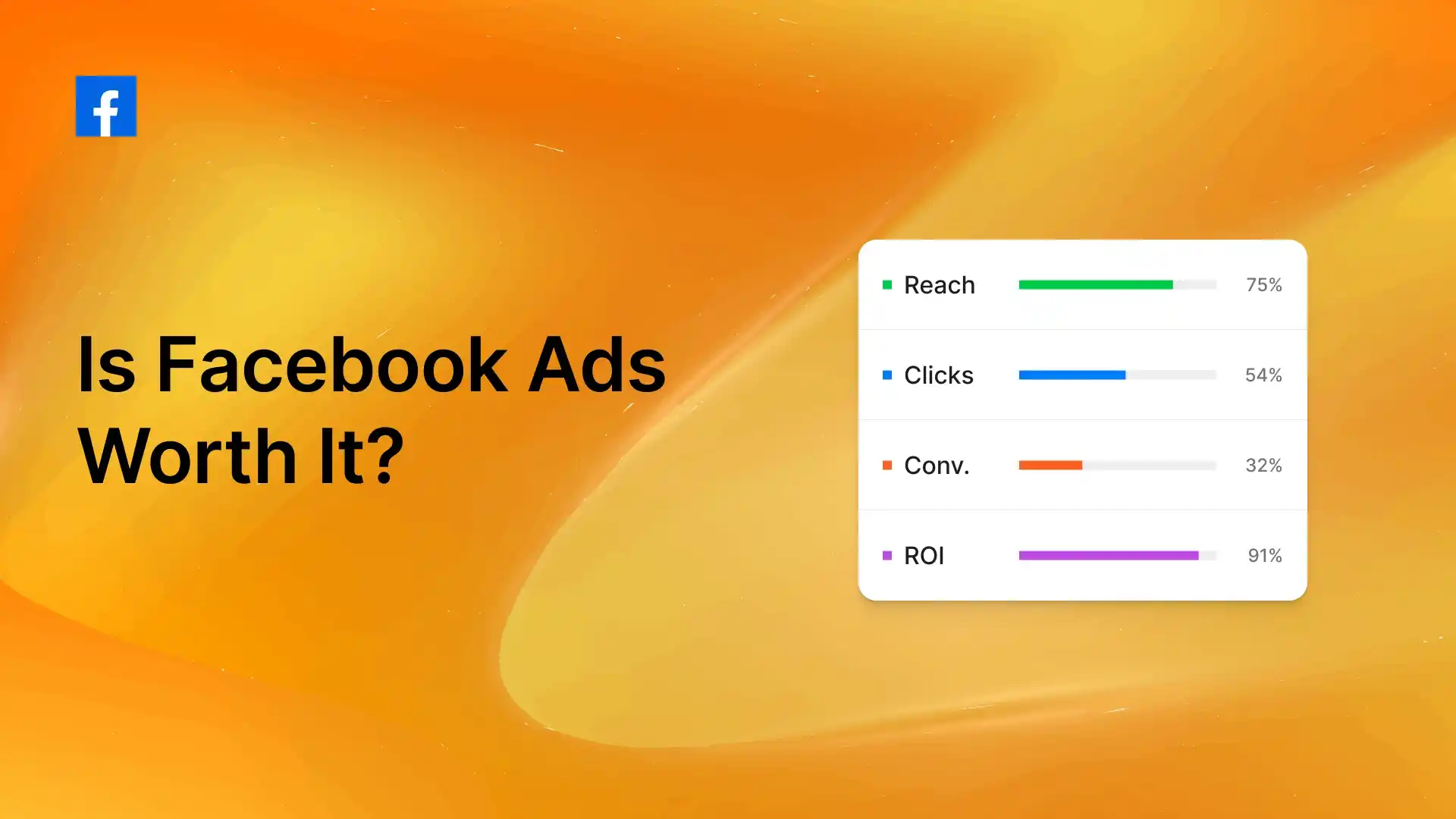
In the table below, you will see that Facebook offers a balanced return on investment across several key metrics:
Another reason the platform is still worth it is the cross-channel impact. A lot of our clients' branded search volume increases by 20% to 30% within months of launching a Meta campaign.
Since the platform owns Instagram and WhatsApp, the ecosystem effect allows you to track a user across their entire digital day, providing a level of attribution that Facebook ads alternatives like TikTok still struggle to replicate with the same maturity.
Also read: How to Measure Facebook Ads ROI
The Biggest Reasons Facebook Is Not Worth It for Some Brands
One thing I tell my clients is to always remember that Facebook ads are a performance multiplier, not a business savior.
Plenty of brands lost thousands of dollars because they viewed the platform as a way to fix a fundamental product-market fit issue.
However, if your unit economics or operational capacity cannot handle the current $25 to $50 customer acquisition cost, the platform will feel like a liability rather than an asset.
Here are some of the common reasons:
Your Offer Is Not Strong Enough Yet
A weak offer is the primary cause of high Facebook advertising costs and poor conversion rates. Users are bombarded with "buy one, get one" or "10% off" discounts that no longer drive immediate action.
If your offer doesn't solve an urgent pain point or provide a unique value proposition that is immediately clear within the first three seconds of an ad, the algorithm will struggle to find a profitable audience.
The most successful brands right now are using bundles, "try before you buy" models, or heavy social proof integrated directly into the headline.
If you are testing a standard product at full retail price against established competitors with aggressive discounting, your Facebook ads are not working because of your positioning, not the platform's targeting.
You Can Not Produce Creative Consistently
Meta’s current Andromeda algorithm update favors high creative velocity. What’s interesting is that the platform now identifies creative similarity, and if you run the same static image for more than two weeks, your CPM will spike as the platform attempts to prevent audience boredom.
If you lack a system to produce 3 to 5 genuinely different ad concepts per month, such as UGC, polished video, and direct-response statics, you will suffer from rapid ad fatigue.
Relying on a single hero ad is a strategy that no longer scales. Our clients' accounts plateau the moment they stop testing new hooks and visual angles.
To make Facebook worth it, you must treat your social media marketing cost as a creative production budget first and a media buying budget second. The strongest results come when a steady flow of new creative concepts is paired with experienced and managed media buying that can quickly identify winning ads and scale them efficiently.
You Have No Retention System
Facebook is an acquisition channel, but profitability is often found in the second and third purchase.
If you are paying $40 to acquire a customer for a $50 product and you have no email automation, SMS marketing, or loyalty program to drive repeat buys, you are operating on a razor-thin margin that cannot survive a temporary spike in CPMs.
Brands with a high Lifetime Value can afford to lose money on the first transaction to gain market share. If your business model relies entirely on "one-and-done" sales, I’d suggest you find safer, albeit slower, alternatives to grow your brand, like SEO or content marketing.
Without a backend retention system, you are essentially trying to fill a bucket that has a hole in the bottom.
Also read: Digital Marketing Agency Pricing in 2026
Who Wins on Facebook in 2026 (The Patterns We See)
Success on Meta in 2026 is reserved for brands that treat the platform as a high-velocity creative engine rather than a technical targeting tool. The winning brands follow a pattern of radical simplification.
They have moved away from complex account structures with dozens of ad sets and instead use a consolidated model that gives the algorithm the data liquidity it needs to stabilize.
Across the high-performing Facebook accounts we manage, I see four distinct patterns that separate the brands scaling profitably from those that are struggling:
Creative Diversity Over Volume
Winners do more than simply post plenty of ads. They post different kinds of ads.
Running five identical UGC videos with slight hook changes is less effective than running one testimonial, one high-production brand story, and one technical explainer.
AS I said, the Andromeda algorithm rewards variety because it allows the system to find different clusters of buyers.
Vertical-First Content
With roughly 90% of Meta’s high-intent inventory now living in vertical formats (Reels and Stories), the brands winning are those designing specifically for 9:16.
If you are still trying to force square or landscape video into these placements, you are effectively paying a premium for lower engagement.
Also read: Facebook Ad Targeting Options
The "Search Lift" Effect
Profitable brands measure success beyond the immediate ROAS in the Meta dashboard. Our firm’s winning accounts maintain a steady baseline of Facebook spend because they see a corresponding 15% to 25% lift in their Google Search conversion rates.
Industry-Specific Fit
Certain sectors are naturally winning more often due to the visual and emotional nature of the platform. Based on 2026 performance data, here are the industries currently seeing the highest engagement:
If you are in a slightly less interesting (re: boring) industry like Finance or B2B Tech, you should know that winning requires a Product Education approach.
You cannot sell a complex software solution with a single image; you must use a video-first funnel that builds trust before asking for the conversion.
Those who try to skip the education phase find that their Facebook ads management services costs outweigh their actual returns.
What Makes Facebook Profitable Now?
I’ve said many, many times that profitability on Meta is all about data quality and creative endurance. The most profitable accounts are those that have moved away from manual adjustments and toward a Server-Side data foundation.
Without the Conversions API (CAPI) sending clean signals back to Meta, the platform only sees about 60% of your actual sales.
The real driver of revenue is the shift toward Advantage+ Shopping Campaigns (ASC).
Sometimes, our clients' cost-per-purchase drops by a lot simply by consolidating their fragmented ad sets into a single ASC environment.
This allows Meta’s new Andromeda retrieval system (which, BTW, is 100x faster than previous models) to test up to 150 creative combinations simultaneously to find the most profitable user segments.
I’ve compiled the following table to show ASC vs. Manual campaign performance benchmarks:
How to Measure Facebook Without Lying to Yourself
As I mentioned previously, simply relying on the ROAS in your Meta dashboard is one of the biggest mistakes agencies can make is relying solely on the ROAS reported in the Meta dashboard.
In most cases, attribution is confusing because of cross-device behavior and privacy restrictions. If you only look at last-click data, you will likely conclude that your ads aren’t working.
When in reality, they are fueling your entire funnel by creating awareness that converts elsewhere.
The only way to measure accurately is to shift your primary KPI to the Marketing Efficiency Ratio (MER). This is calculated by taking your Total Revenue and dividing it by your Total Ad Spend across all channels.
If your MER remains healthy as you scale your Facebook budget, the ads are working, regardless of what your dashboard displays.
Mixed MER Formula: Total Revenue ÷ Total Marketing Spend = MER. A healthy benchmark for a scaling brand is usually 3.0 or higher.
The Incrementality Test: I often suggest my clients run a holdout test where they stop Facebook spend in one specific geographic region for two weeks. If total revenue in that region drops by more than the "saved" ad spend, the ads were driving incremental value that the pixel missed.
Post-Purchase Surveys: I always recommend using a simple "How did you hear about us?" survey on the thank-you page. You will often find that 30% to 40% of customers credit Facebook, even if the dashboard shows no direct attribution for that user.
Related article: Social Media Management Pricing
How Much Budget Do You Need for Facebook to Be “Worth It”
The minimum budget for Facebook is dictated by the math of the Learning Phase. To exit this phase and stabilize your costs, Meta’s algorithm needs roughly 50 conversions per ad set, per week.
If your target customer acquisition cost is $30, you need a weekly budget of at least $1,500 ($215 per day) per ad set to give the machine enough data to optimize.
Based on current trends, here is how I recommend structuring your daily spend based on your specific business goals:
If your budget is tight, then it is better to run one campaign with a $50 daily budget for two weeks than to spread that same $700 across five different campaigns for a month.
Also read: Instagram Ads Cost in 2026
The Fastest Way to Know if Facebook Can Work for You
The fastest way to validate the platform is to run a Stress Test using a single Advantage+ Shopping campaign. Instead of complex interest groups, you use broad targeting and three distinct hero creatives: one UGC-style testimonial, one high-contrast static benefit image, and one problem-solution video.
Run this for a minimum of seven days with a budget that is at least 3x your target CAC. If you are not seeing a CTR of at least 1.2% or an "Add to Cart" rate of at least 3% by day four, the issue is with your offer or your creative, instead of Facebook itself.
If the results are poor after a clean seven-day test, then it’s time for a Facebook ads audit to check for technical tracking errors or landing page issues.
If the technical side is sound and the ads still fail to convert, it is a clear signal that you need to pivot your creative strategy or refine your core offer before committing more of your marketing budget to the platform.
The Key Takeaways
Facebook remains a dominant force in 2026 because of its sheer volume of data and the efficiency of its automated delivery systems. I would say the platform is "worth it" for any brand that has a high enough average order value to absorb a $30+ customer acquisition cost.
Success comes from a disciplined approach to creative production and a data foundation built on server-side tracking. If you can feed the algorithm high-quality creative and clean conversion data, Meta's ability to scale your sales is incomparable to any other channel.
It will scale a winning product and a strong offer, but it will also quickly burn through a budget if your creative is stale or your website is difficult to navigate.
For those looking to grow, partnering with a specialized Facebook ads agency can help take your brand from simply "running ads" to building a profitable engine.
Why Do Facebook Ads Feel More Expensive Than They Used To?
The rise in costs is primarily driven by increased competition for the same high-intent placements and Meta's shift toward privacy-safe data models.
CPMs have risen because the platform now prioritizes user experience, meaning you must pay a premium for your ad to be shown to the most likely buyers.
What Budget Do I Need to Test Facebook Ads Properly?
A proper test requires a minimum of $50 to $100 per day for at least 7 to 14 days to provide the algorithm with enough data. I've seen that testing with less than $1,500 per month often leads to statistical noise where you cannot definitively prove if the platform works for your brand.
This testing phase allows the pixel to identify your ideal customer profile and establishes a baseline cost per acquisition.
Is Instagram Better Than Facebook for Ads in 2026?
The choice between Facebook ads vs. Instagram ads depends entirely on your creative format and target demographic, though both are managed through the same Meta dashboard.
Reels and Stories on Instagram often yield a lower CPM for visual, lifestyle-driven brands, while the Facebook News Feed still tends to convert better for high-intent lead generation and older demographics.
Most high-performing campaigns today use automatic placements to let the algorithm decide the split based on real-time performance.
How Do I Measure Facebook Ads When Attribution Is Messy?
Accurate measurement requires moving away from the "Last Click" model and adopting a "Blended MER" (Marketing Efficiency Ratio) approach.
You should track the total revenue of your business relative to your total ad spend, rather than relying only on the Meta dashboard. Using third-party attribution tools and post-purchase surveys will help you see the influence Facebook has on your branded search and direct traffic.
How Long Should I Run Ads Before I Decide Whether They Work or Not?
You should run a consistent campaign for at least 14 to 30 days before making a final decision on its viability. The first week is usually the Learning Phase, where performance is volatile as the system finds your audience.
Whereas the second and third weeks provide the stabilized data you need to judge if the ROAS is sustainable for your business model.
When Should I Stop Spending on Facebook and Switch Channels?
You should consider switching to alternatives if your CAC exceeds your lifetime customer value even after three rounds of creative testing.
If you have audited your landing page and performed a thorough audit without seeing improvement, your product may be better suited for search-based platforms like Google or high-engagement platforms like TikTok.


.webp)